Thursday, January 30, 2014

CHAPTER 8 : ACCESSING ORGANIZATIONAL INFORMATION - DATA WAREHOUSE

Data Warehouse Fundamentals :

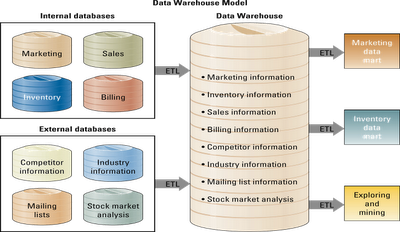
Data warehouse - a logical collection of information, gathered from many different operational databases that supports business analysis activities and decision making tasks.
Primary purpose of a data warehouse is to aggregate information throughout an organization into a single repository decision-making purposes.
Extraction, transformation, and loading (ETL) - a process that extracts information from internal and external databases, transform the information using a common set of enterprise definitions, and loads the information into a data warehouse.
Data mart - contains a subset of data warehouse information.


Multidimensional Analysis and Data Mining :

Cube - common term for the representation of multidimensional information.
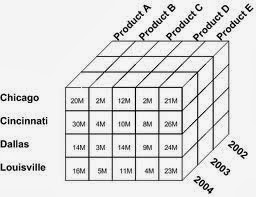


Data Mining - the process of analyzing data to extract information not offered by the raw data alone.
Data Mining Tool - uses a variety of techniques to find patterns and relationships in large volumes of information and infers rules that predict future behaviour and guide decision making.

Information Cleansing or Scrubbing :

Is a process that weeds out and fixes or discards inconsistent, incorrect, or incomplete information.

Business Intelligence :

Information that people use to support their decision making efforts.
Principle BI enablers includes technology, people and culture.

CHAPTER 7: STORING ORGANIZATIONAL INFORMATION - DATABASE

Database - maintains information about various types of objects (inventory), events (transactions), people (employees), and places (warehouse).
Database models :

Hierarchical database model - information is organized into a tree-like structure (using parent/child relationship) in such a way that it cannot have too many relationship.
Network database model - a flexible way of representing objects and their relationships.

Relational database model - stores information in the form of logically related two-dimensional tables.

Entities and Attributes :

Entities is a person, place, thing, transaction, or event about which information is stored. The rows, in each table contain the entities.
Attributes (fields, columns) is characteristics or properties of an entity class. The columns in each table contain the attributes.

Keys and Relationship :

Primary key - a field (or group of fields) that uniquely identifies a given entity in a table.

Foreign key - a primary key of one table that appears an attribute in another table and acts to provide a logical relationship among the two tables.

Relational Database Advantages :

Increased flexibility - a well-designed database should handle changes quickly and easily and provide users with different view.
Increased scalability performance - scalability refers to how well a system can adapt to increase demands. And performance is to measures how quickly a system performs a certain process or transaction.

Reduced information redundancy - redundancy is the duplication of information or storing the same information in multiple places.

Increased information integrity (quality) - information integrity is to measures the quality of information. And the integrity constraint is the rules that help ensure the quality of information. Relational integrity constraint and business-critical integrity constraint.

Increased information security - password provides authentication of the user,access level determines who has access to the different types of information, and access control determines types of user access, such as read-only access.

Database Management Systems :

Software through which users and application programs interact with a database.

Database-Driven Websites :

An interactive website kept constantly updated and relevant to the needs of its customers through the use of a database.

Integrating Information among Multiple Databases :

Integration is allows separate systems to communicate directly with each other. there has two ways is -forwards integration is takes information entered into a given system and sends it automatically to all downstream systems and processes. then, backward integration is takes information entered into a given system and sends it automatically to all upstream systems and processes.

Saturday, January 25, 2014

Chapter 6 : Valuing Organizational Information

Organizational Information:
Information granularity refers to the extent of detail within the information (fine and detailed or coarse and abstarct).


The Value of Transactional and Analytical Information:
Transactional information encompasses all of the information contained within a single business process or unit of work, and its primary purpose is to support the performing of daily operational tasks.
Analytical information encompasses all organizational information, and its primary purpose is to support the performing of managerial analysis tasks.


The Value of Timely Information:
Real-time information means immediate,up-to-date information.
Real-time systems provide real-time information in response to query requests.


The Value of Quality Information:


The four primary sources of low quality information are:

Online customers intentionally enter inaccurate information to protect their privacy.
Different systems have different infomartion entry standards and formats.
Call center operators enter abbreviated or erroneous information by accident or to save time.
Third-party and external information contains inconsistencies, inaccuracies, and errors.
Understanding the cost of poor information

Inability to accurately track customers, which directly affects strategic initiatives such as CRM and SCM.
Difficulty identifying the organization's most valuable customers.
Inability to identify selling opportunities and wasted revenue from marketing to nonexisting customers and nondeliverable mail.
Difficulty tracking revenue because of inaccurate invoices.
Inability to built strong relationship with customers-which increases buyer power.

Chapter 5 : Organizational Structures That Support Strategic Initiatives

Organizational Structures:
Organization must work closely together to develop strategic initiatives that create competitive advantages.


IT Roles and Responsibilities:


Chief Information Officer (CIO)- responsible for overseeing all uses of information technology and ensuring the strategic alignment of IT with business goals and objectives.


Chief Technology Officer (CTO)- responsible for ensuring the throughput, speed, accuracy, availability, and reliablity of an organization's information technology.


Chief Security Officer (CSO)- responsible for ensuring the security of IT systemand developing strategies and IT safeguards againts attacks from hackers and viruses.


Chief Privacy Officer (CPO)- responsible for ensuring the ethical and legal use of information within an organization.


Chief Knowledge Officer (CKO)- responsible for collecting, maintaining, and distributing the organization's knowledge.


The Gap Between Business Personnel and IT Personnel:
Business personnel posses expertise in fuctional areas such as marketing, accounting, sales, and so forth.
IT personnel have the technologucal expertise.
Unfortunately, a communications gap often exists between the two.


Improving Communication:
Business personnel must seek to increase their understanding of IT. IT personnel must understand the business if the organization is going to determine which technologies can benefit (or hurt) the business.
It is the responsibility of the CIO to ensure effective communication between busniess and IT personnel.


Ethics
the principles and standards that guide our behavior toward other people.


Privacy
the right to be left alone when you want to be, to have control over your own personnel possessions, and to not be observed without your consent.

Chapter 4 : MEASURING THE SUCCESS OF STRATEGIC INITIATIVES

Key performance indicator – measures that are tied to business drivers


Metrics are detailed measures that feed KPIs

Performance metrics fall into the nebulous area of business intelligence that is neither technology, nor business centered, but requires input from both IT and business professionals

Efficiency and Effectiveness

Efficiency IT metric – measures the performance of the IT system itself including throughput, speed, and availability

Effectiveness IT metric – measures the impact IT has on business processes and activities including customer satisfaction, conversion rates, and sell-through increases

Benchmarking – Baselining Metrics

Regardless of what is measured, how it is measured, and whether it is for the sake of efficiency or effectiveness, there must be benchmarks – baseline values the system seeks to attain

Benchmarking – a process of continuously measuring system results, comparing those results to optimal system performance (benchmark values), and identifying steps and procedures to improve system performance


Efficiency IT metrics

Throughput - the amount of information that can travel through a system at any point
Transaction speed - the amount of time a system takes to perform a transaction
System availability - the number of hours a system is available for users
Information accuracy - the extent to which a system generates the correct results when executing the same transaction numerous times
Web traffic - includes a host of benchmarks such as the number of page views, the number of unique visitors, and the average time spent viewing a Web page
Response time - the time it takes to respond to user interactions such as a mouse click

Effectiveness IT metrics


Usability - The ease with which people perform transactions and/or find information. A popular usability metric on the Internet is degrees of freedom, which measures the number of clicks required to find desired information.
Customer satisfaction - Measured by such benchmarks as satisfaction surveys, percentage of existing customers retained, and increases in revenue dollars per customer.
Conversion rates - The number of customers an organization “touches” for the first time and persuades to purchase its products or services. This is a popular metric for evaluating the effectiveness of banner, pop-up, and pop-under ads on the Internet.
Financial - Such as return on investment (the earning power of an organization’s assets), cost-benefit analysis (the comparison of projected revenues and costs including development, maintenance, fixed, and variable), and break-even analysis (the point at which constant revenues equal ongoing costs).

The Interrelationships of Efficiency and Effectiveness IT Metrics

Security is an issue for any organization offering products or services over the InternetIt is inefficient for an organization to implement Internet security, since it slows down processing

However, to be effective it must implement Internet security Secure Internet connections must offer encryption and Secure Sockets Layers (SSL denoted by the lock symbol in the lower right corner of a browser)

Friday, December 20, 2013

Chapter 3: Strategic Initiatives For Implementing Competitive Advantages

STRATEGIC INITIATIVES.
  Organizations can undertake high-profile strategic initiatives including:
  •  Supply chain management (SCM)
  • Customer relationship management (CRM)
  • Business process reengineering (BPR)
  • Enterprise resource planning (ERP)

SUPPLY CHAIN MANAGEMENT.
Involve the management of information flows between and among stages in a supply chain to maximize total supply chain effectiveness and profitability.
Four basic components of supply chain management include:
  •   Supply chain strategy- strategy for managing all resources to meet customer demand.
  •  Supply chain partner- partner throughout the supply chain that deliver finished products, raw materials and services.
  •  Supply chain operation- schedule for production activities.
  • Supply chain logistics- product delivery process.

CUSTOMER RELATIONSHIP MANAGEMENT.
 Involve managing all aspects of a customer’s relationship with an organization to increase customer loyalty and retention and an organization’s profitability.
CRM is not just technology, but also a strategy, process and business goal that an organization must embrace on an enterprisewide level.
 CRM can enable an organization to:
  • Identify types of customers.
  • Design individual customer marketing campaigns.
  • Treat each customer as an individual.
  • Understand customer buying behaviors.

BUSINESS PROCESS REENGINEERING.
  • A standardized set of activities that accomplish a specific task, such as processing a customer’s order.
  • The analysis and redesign of workflow within and between enterprises.

ENTERPRISE RESOURCE PLANNING.
  • Intergrates all departments and functions troughout an organization into a single IT system so that employees can make decisions by viewing enterprisewide information on all business operations..
  • ERP systems collect data from across an organization and correlates the data generating an enterprisewide view..
jj


Thursday, December 12, 2013

Chapter 2 - Identifying Competitive Advantage

A product or services that an organization’s customers place a greater value on than similar offerings from a competitor.

Michael Porter’s Five Forces Model is useful tool to aid organization in challenging decision whether to join a new industry or industry segment.


Buyer Power
·         High – when buyers have many choices of whom to buy
·         Low – when their choices are few
·         To reduce buyer power (and create competitive advantage), an organization must make it more attractive to buy from the company not from the competitors
·         Best practices of IT based -  Loyalty program in travel industry, for example rewards on free airline tickets or hotel stays

The Competitive Environment

Bargaining Power of Customers/Buyer Power
  • Customers can grow large and powerful as a result of their market share
  • Many choices of whom to buy from
  •  Low when comes to limited items
  • Example, used loyalty programs (Jusco card, Tesco card, being a members to get the discount)

Supplier Power
·         High – when buyers have few choices of whom to buy from
·         Low – when their choices are many
-    Best practices of IT to create competitive advantage
-    Example, B2B marketplace – private exchange allow a single buyer to posts it needs and then open the bidding to any supplier who would care to bid. Reverse auctionis an auction format in which increasingly lower bids

An organization within the Supply Chain
  • -          Supplier power is the converse of buyer power

Threat of Substitute products and services
·         High – when there are many alternatives to a product or service
·         Low – when there are few alternatives from which to choose
·         Ideally, an organization would like to be on a market in which there are few substitutes of their product or services
- Best practices of IT
- Example, Electronic product – same functions different brands

The Competitive Environment

Threat of Substitutes
  • -          To the extent that customers can use different products to fulfill the same need, the threat of substitutes exists
  • -          Example, electrical product – same function different brands
  • -          Switching cost – costs can make customer reluctant to switch to another product or service

Threat of new entrants
·         High – when it is easy for new competitors to enter a market
·         Low – when there are significant entry barriers to entering a market
·         Entry barriers is a product or service feature that customers have come to except from organizations and must be offered by entering organization to complete and survive
·         Best practices of IT
-     Example, new bank must offers online paying bills, acc. monitoring to compete

The Competitive Environment

Threat of New Entrants
  • -          Many threats come from companies that do not yet exist or have a presence in a given industry or market
  • -          The threat of new entrants forces top management to monitor the trends, especially in technology, that might give rise to new competitors
  • -          Example, new bank (online paying bills, acc. monitoring)

Rivalry among existence competitors
·         High – when competition is fierce in a market
·         Low – when competition is more complacent
·         Best practices of IT
-    Wal-Mart and its suppliers using IT – enabled system for communication and track product at aisles by effective tagging system
-    Reduce cost by using effective supply chain

The Competitive Environment

Rivalry Among Existing Firms
  • -          Existing competitors are not much of the threat: typically each firm has found its “niche”.
  • -          However, changes in management, ownership, or “the rules of the game” can give rise to serious threats to long term survival from existing firms
-          Example, the airline industry faces serious threats from airlines operating in bankruptcy, who do not the debts while slashing fares against those healthy airlines who do pay on debt. (MAS & AIR ASIA)

Three Generics Strategies


The Value Chains – Targeting Business Processes
  • Supply Chain – a chain or series of processes that adds value to product and service for customer
  •  Add value to its products and services that support a profit margin for the firm